
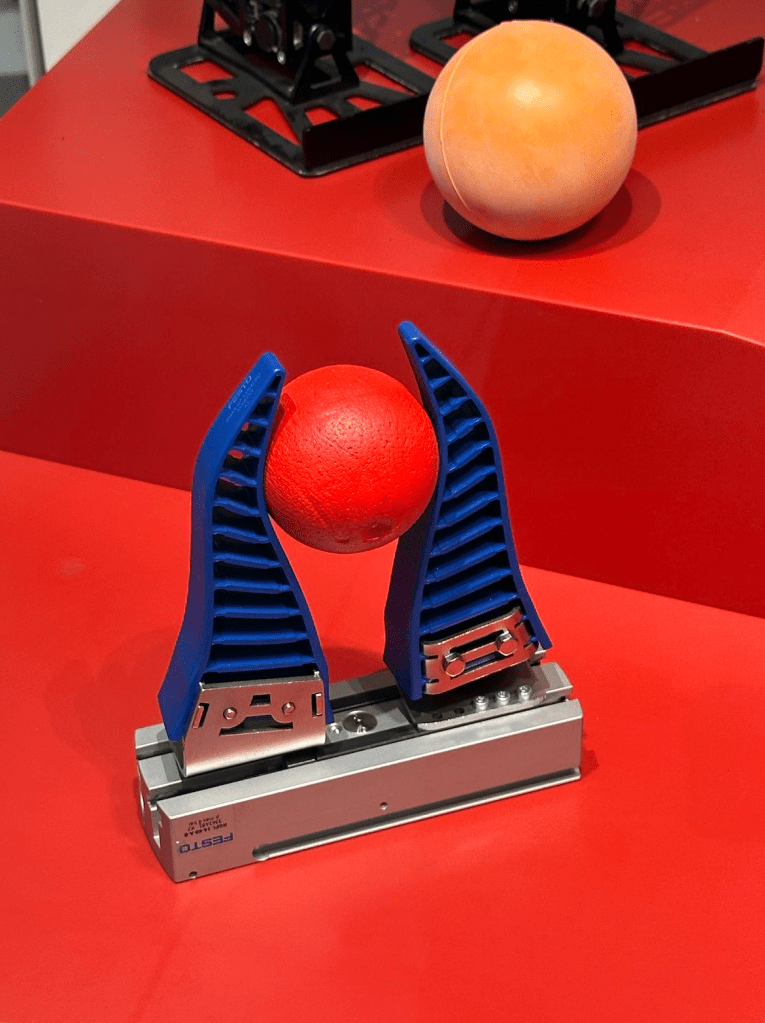
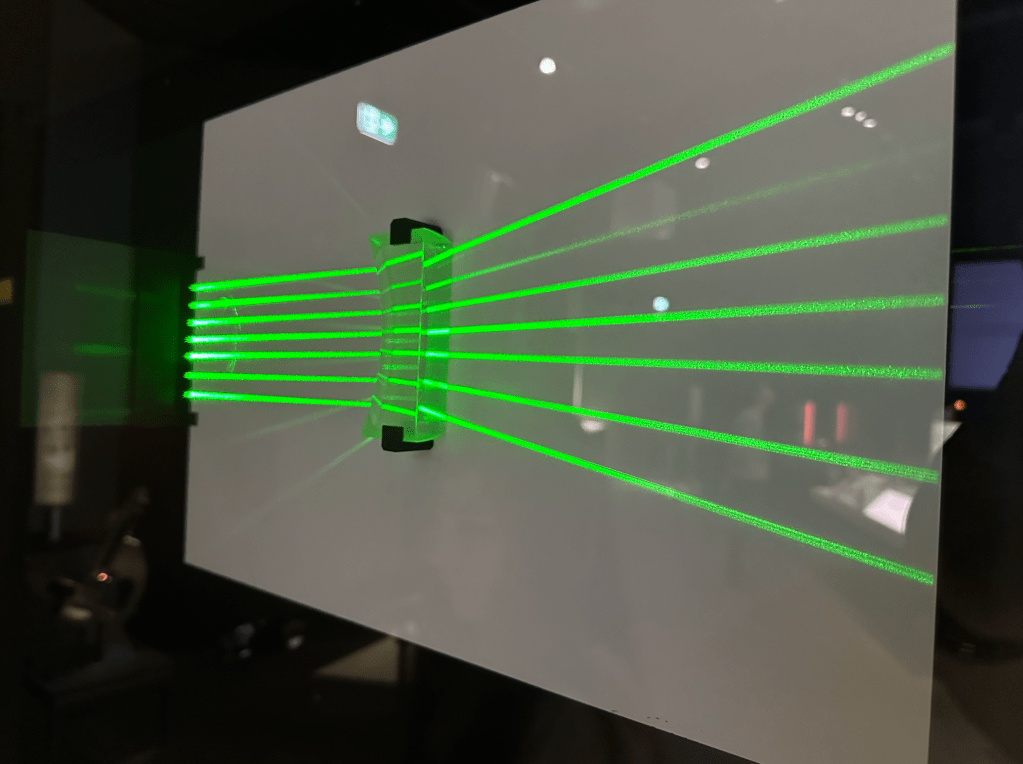
I recently went on a trip to Germany and decided to visit the German Museum in Munich. Currently, the museum houses a variety of exhibits on robotics, cryptography, mathematics, physics, and more! The pictures above show two pieces I learned more about in the robotics and physics exhibits.
The first picture shows a fin ray gripper. The fin ray gripper was invented by a German biologist named Leif Kniese. The two grippers are designed to imitate fish fins, which bend towards and encompass an applied force. Traditional robotic grippers have trouble picking up round or irregularly shaped objects, whereas the fin ray gripper does not. The fin ray consists of soft triangular fingers, or grippers, that can bend around objects. Inside, hard cross sections are used for structure, while still allowing flexibility.
The second image shows how a concave lens can affect light. The concave lens causes parallel light beams to diverge outwards. Similarly, a convex lens would converge parallel beams of light. Convex and concave lenses are also used in glasses to help correct eyesight. Nearsighted people wear glasses with concave lenses, while farsighted people wear glasses with convex lenses.
I loved visiting and walking through the German Museum! I am glad I got to see and explore so many different inventions and models while still having a hands on experience!
 Keys to Knowledge